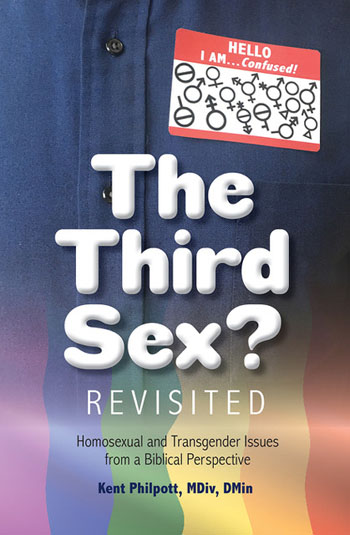
What followed the publication of The Third Sex?
For some period of time, a few weeks, four of us met in my office at the Christian General Store at 2140 Fourth Street in San Rafael. We were joined by three women, all self-described homosexuals. One of the ladies came up with a name for our little group, others joined in and before long an actual ministry was under way. It was suggested we notify others of what we were doing so the idea for The Third Sex? was born. Since I had a book already in print, A Manual of Demonology and the Occult, published by Zondervan in 1973, it was decided that I should write the book.
That which followed the publication of The Third Sex? in 1975 and then a couple of years later, its sequel, The Gay Theology, could be described as something analogous to a whirl wind. At times I regretted the publications due to the grief that descended upon me and my family, which continues, to one degree or another, even to the present day.
Though I had been trained as a counselor I was not prepared for dealing with people who had the misfortune of being involved deeply in homosexuality. It was difficult for me to understand the pain and frustration they were enduring. Though I could present Bible truths and could patiently listen to their stories, I could never get inside their skin as a heterosexual who did not have a very clear understanding of the gay life.
On the door step
From all over the country people were arriving hoping to find a way to leave their homosexual behavior behind. There were, in the broad sense, two motivations that brought them to San Rafael and the ministry we had developed, Love in Action. One, as Christians they wanted to follow Jesus more carefully and they knew that homosexual behavior was neither biblical and nor pleasing to their Lord. Some of these had been to pastors and other ministers who saw nothing wrong with homosexuality and who then attempted to confirm or affirm them in their sinful ways. Usually such unbiblical counsel worked for a season only. The Holy Spirit we found would not endorse homosexuality so any “fix” was merely temporary.
Two, there were those who showed up who were not Christians but were desperate to leave the gay lifestyle. From these people I learned that the designation “gay” did not accurately describe the day-by-day life of the homosexual. Many of these were older, both men and women but mostly men, the “aunties” whose bodies were not what they were and found that the gay life was one of repeated rejections, that or the sex lives they were forced into was not acceptable. And, by the way, this was all before the days of HIV and AIDS.
Often there would be a knock at the door and there would be a poor creature, sometimes without baggage or money in the pocket, wondering if he or she had found Kent Philpott and Love in Action.
None of these came to have a surgical operation performed. Few desired to become heterosexual; in fact, it was usual that they figured they would be gay in their mind all the rest of their lives. They simply wanted to be faithful followers of Jesus Christ.
Reparative therapy
Those who opposed us, the gay activists, enjoyed saying we were trying to make heterosexuals out of homosexuals. Such a process is called reparative therapy. And oppose us they did. For a short period gay activists showed up at Carpenter’s Hall on Lindaro Street in San Rafael and picket the morning worship services of Church of the Open Door were I was the senior pastor. Attempts were made to intimidate worshippers and there would be efforts to sneak into the services as well. Yes, there were death threats phoned in and rumors were spread about that I was homosexual, a pedophile to be exact, and was only repressing my natural, gay, inclinations.
Changing a homosexual into a heterosexual–that was a lie then and it is a lie now. It may actually be that someone out there has this as a goal, but I have never found one. To the complete contrary, we were almost overwhelmed by people who wanted out of the gay life, men and women.
If a person believed they would always be homosexual in their minds and emotions, even in their sexual attractions, this was not something we attempted to deal with, at least as long as I was involved in Love in Action. I have heard it said that things changed in 1978 after I withdrew from active participation in the day-by-day operation of the work, but I have never had this confirmed though I tried to do so.
Our goal was peace and joy in the Holy Spirit and living in the kingdom of God so as to glorify Jesus. To have homosexual desires did not mean they would have to be acted upon. Now there was a higher calling. Before the focus was on sex to the point of addiction. Being a follower of Jesus was not a sublimating exercise either; rather it was the calling of God. Those outside of a converting faith would never grasp our core message but instead felt obliged to distort it.
A simplistic, but perhaps useful, breakdown into “types”
So many of those who came to us had somehow been seduced into homosexuality at a young age, in some cases, a very young age. Over and over I would hear these people say that they had never had a heterosexual thought. Due to dysfunctional parent/child relationships, their sexual identity was confused from the very beginning. Then, their first sexual experience was with a homosexual, usually an older homosexual, and they had learned to have physical pleasure in that context. Gradually a gay identity took shape and gayness would even be affirmed as a superior, a cleaner, way of life. Antagonism would be developed for those of the opposite sex. Any thought of marriage and children would be scoffed at—sometimes any suggestion of sexual contact with someone of the opposite sex would be likened to something vile. It was with this group in particular that I felt most empathy, but I discovered I was ill equipped to be of much help.
A group of persons that progress was more easily made was with those who had developed a gay identity in their teen years. Perhaps shyness or fear of the opposite sex was the underlying issue, but the early sexual experience was of a homosexual nature and once the natural barrier was down, homosexual behavior became attractive. Some of these would refer to themselves as bisexual, but it was usual that the homosexuality predominated.
Then there were those who had acquired a taste for homosexuality in some kind of institutional setting—group home, boarding school, the military, or some sort of lock up—juvenile hall, prison, and so on. It was not unusual for some of these to be described as sexual opportunists, but for the Christians among them, they knew such sexuality was not what God wanted whether it be of a homosexual or heterosexual nature.
Successes and failures
Love in Action was the most problematic ministry I have ever engaged in. For one thing we were besieged by precious people desperate for help. Many had been used and abused for much of their lives, some were suicidal, and others were looking for another rejection. But we kept meeting. Frank Worthen did a remarkable job working with those who struggled the most. Slowly, but very slowly, there was healing in many areas and potential leaders began to emerge.
Then, fairly early on, one of those who formed the second tier of the group, Bill,[1] committed suicide in the psychiatric ward of the local hospital. Some of the original group blamed Love in Action, mainly Frank and I, for the death. It was said that Bill could not break away from the gay life and out of unrelenting guilt decided to end it all. These grieving people began espousing the idea that homosexuality could not be changed but must be accepted as normal. Love in Action, it was said, tried to force change and the failure, the suicide, was proof that a born homosexual was just that.
Bill himself did not blame anyone, not Frank, myself, or Love in Action. (I have a copy of his suicide note.) Nevertheless, the story will yet surface to the effect that homosexuality should not, cannot, be changed. Bill did struggle, and mightily, and I for one was unable to communicate grace and mercy to him, could not enable him to see that He was completely forgiven and secure in Christ. Bill’s suicide has troubled me all these years.
There were other failures but much less dramatic. Several of those whom I had interviewed for The Third Sex? and The Gay Theology did return to homosexuality. This is beyond dispute. But others continue faithful to their Lord and to Scripture.
Those who came to Love in Action from various parts of the United States, and from other countries, discovered it was not an easy to make the necessary adjustments. The Church of the Open Door did well to meet their needs and established more of what we called Christian Houses. The congregation quickly adjusted to an influx of gay people then and demonstrated genuine acceptance. Instead of driving people away, the opposite was what we experienced. Some of those who came to Love in Action became leaders and ministers with the church. This yet continues but Love in Action moved to Tennessee years ago while Frank Worthen continues the work he began in the early 1970s, and now accompanied by his wife Anita, who also came out of the gay life.[2]
The opponents and why they would oppose
It became abundantly clear to me that our opposition was highly motivated and energetic. There were the protests, the pickets, and the rumors—like I would not have imagined.
It took some time for me to understand the radical nature of the opposition, which is still very much in place and even more so due to the success they have achieved both within and without the American Christian community, and elsewhere of course. At stake was the core identity of those who argue they were born homosexual and so are homosexual by the will of God. It is either that, for those who count themselves within the Christian community, or turn away from homosexual behavior. And I admit that it is harder for some than others to go against that core sexual identity.
Since the culture, apart from the Christian Church, is rather fluid in regard to how homosexuality is viewed, there is little the gay activist has to be concerned about. With a broad range of civil rights established for gays and a growing acceptance and approval, what remains as a threat to the gay outlook is the moral and ethical views of Bible based Christians. Let it be noted that I have not witnessed gay activists going after Buddhists, Hindus, Muslims, or even the liberal end of the Christian spectrum. The latter are ignored because these have so often become allies in the struggle for gay acceptance. More on this issue will follow.
The Bible, and those who abide by it, is the problem for the gay activist. The usual method of attacking the Bible is to assert that the Bible is not talking about homosexuality at all, but when Scripture appears to be speaking to the issue in reality it is only speaking about the abuse of homosexual practices much as the Bible speaks of adultery or rape. Or, the Bible is culturally conditioned, that is, it was written for a different circumstance in a far removed time and place. These two arguments are part of a twin attack since they are so closely linked.
Moral failures on the part of Christian leaders are used to discredit the whole of the Christian worldview. Then there are those known for their opposition to homosexuality who subsequently turned out to be gay themselves—the usual “attack the messenger” approach. And there are other points that could be discussed, but the issue is that it has not been enough for the gay community to win the civil rights battle; it is really the need to be able to feel that they are perfectly normal and right. Therefore, those who stand for a biblical perspective on homosexual behavior must be countered.
Gay activist success and how they did it
During the 1970s, because of the publication of The Third Sex? and The Gay Theology, I was a part, to some degree, in the debates that went on in some Christian denominations on the issue of homosexuality. From 1976 to 1980 I was a doctoral student, DMin., at the Presbyterian school, San Francisco Theological Seminary in San Anselmo, California—while I was also pastor of Church of the Open Door in San Rafael. On a number of occasions I was part of a panel of church leaders debating gay issues, or a speaker at church events focused on the topic, or part of some sort of media presentation, news program sometimes, dealing with homosexuality.
Once, at the seminary in San Anselmo, probably in 1979, I was with a gathering of gay activists where strategy for their agenda was being discussed. It was a boisterous group that was exulting after what they considered to be a victory in a debate on homosexuality. Apparently they did not know that one of those listening in was not one of them. At any rate, I heard outlined a most startling plan for the legitimizing of homosexuality. The chief means was to be the persuading of Christian denominations that a new civil rights fight was to be fought—the right to be gay in American with all the rights and privileges attending heterosexuals. And the battle would not be waged in the pews but in the offices and corridors of the headquarters of major denominations.
One statement made at that time, and which has stayed with me all these years is: “And the enemy is the born againers.”
The strategy I heard outlined back then worked. One after the other, major denominations adopted the “gay rights struggle” as they had the civil rights movement for blacks in the 1960s. It yet goes on, only now it comes under the label “Social Justice.” And who is against social justice for all? I am not and I know of no Christian leader who is. Certainly Christians of all varieties are for social justice, but in the process there is the danger that Christians might relinquish the moral and ethical standard that homosexual behavior is sinful.
How can the Christian community that is biblically faithful work for social justice for gays? What about gay marriage and adoption? Where will it end? Already in elementary schools young children are taught to view homosexuality as normal and good. Christians like me face a real challenge, a serious dilemma—and it is not easily resolved. Perhaps it must be acknowledged that, again, we live in a two-kingdom world. The church will be the church while functioning in the world, and at the same time, be law observant even if it means a kind of compromise. This is how it is working now in the county in which I live.
Gay rights and the inevitable
My views on homosexuality are decidedly in the minority. Yes, there are those who remain true to the clear teaching of Scripture, but the faithful base is being eroded. Such is not the case everywhere. There are areas of America that remain a challenge for the gay activist, but the law of the land is on their side and eventually they will prevail.
However, that said, it is not enough for the gay community to have full rights under the law, it is what others think that matters most to them. It is simply unacceptable that people like me think and believe that there is something wrong with homosexuality. As long as the “born againers” are taking a stand that homosexual behavior is sinful, the gay activists will fight. So the battle lines are drawn and biblically faithful Christians must wage their warfare in a way that their Lord Jesus would do so, with grace, mercy, and prayer.
The issue of how the broad Christian Church views homosexuality may divide it more so than it already is. In a way, we can celebrate denominationalism since it is probable that not all groups will cave into the culture. Imagine one single monolithic organization as was common to the world’s Middle Ages. This is an age of the rising and falling of many. Do I dare say that there are churches already not worthy of the identification but have morphed into something else, something other than a center of a proclamation of the person and work of Jesus Christ. This is hardly a point worth arguing. There is a biblical passage that may be relevant here: “They went out from us, but they were not of us; for if they had been of us, they would have continued with us. But they went out, that it might become plain that they all are not of us” (1 John 1:19)[3]
A perspective on the Scripture and homosexuality
In several chapters that follow I will look at the biblical material in regard to homosexuality, but at this point a few general points could be made.
More than once I have examined the Scripture to see whether there was any wiggle room for those who wanted to be openly gay and Christian. Could it be that one could continue in homosexual behavior and still be a faithful follower of Jesus? In short, and in the next chapter, I will present my view of what the Scripture has on it. The conclusion I have come to is that the original intent of God for human sexuality does not include homosexuality.
Not a few times have I gotten to know those whom I felt, notice the word “felt,” were genuine Christians but who were at the same time living a homosexual life. It was not uncommon for people to request help out of the gay life who were at the time living with a lover. It was all so confusing at times, but we had to deal with what was in front of us.
There is no sure fire way for anyone to know if one is actually born from above or not, but there are those instances that make me wonder if it is a situation where one is converted but living the gay life anyway. I have realized, after fifty years in the pastoral ministry, that not all Christians, and perhaps very few, are careful followers of Jesus in line with the biblical moral ethic.
What I have seen is persons who were stubbornly, even
desperately holding on to both the gay life and biblical passages as proof
texts for their behavior, change, repent, and acknowledge their error.
[1] Not his real name.
[2] Frank Worthen died some two years ago.
[3] Another passage along the same line is 1 Corinthians 11:19. Paul, concerned about differing understandings about the Lord’s Supper and the divisions generated in the church as a result said, “there must be factions among you in order that those who are genuine among you may be recognized.”